Free 1907 Quarter Value Calculator
Select your coin's mint mark, condition, and any known error varieties, then hit Calculate for an instant estimate.
If you're not sure of your coin's mint mark or grade, there's a free 1907 Quarter Coin Value Checker online tool that estimates value from uploaded photos without needing prior knowledge of grading.
Describe Your 1907 Quarter for a Detailed Assessment
Not sure which calculator fields to pick? Describe what you see and our analyzer will interpret it for you.
Mention these things if you can
- Mint mark letter (D, O, S, or none)
- How readable is "LIBERTY" on the headband?
- Any shine or luster visible?
- Condition: worn, decent, sharp, gem-like?
Also helpful
- Any doubling on the date or stars?
- Doubled or unusual mint mark?
- Coin struck off-center?
- Deep cameo contrast (proof-like)?
Skipped the calculator?
Get an instant value estimate — no account needed. Takes under 60 seconds.
1907-S Barber Quarter Self-Checker
The 1907-S is the scarcest of all four mint issues — and the most often misidentified. Use this quick visual checklist to confirm whether your coin is truly a San Francisco strike in collectible grade.
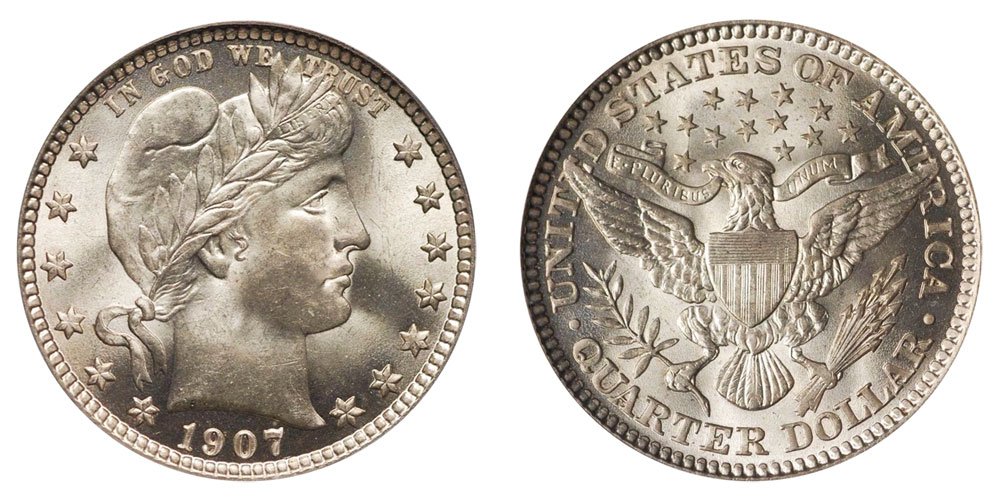
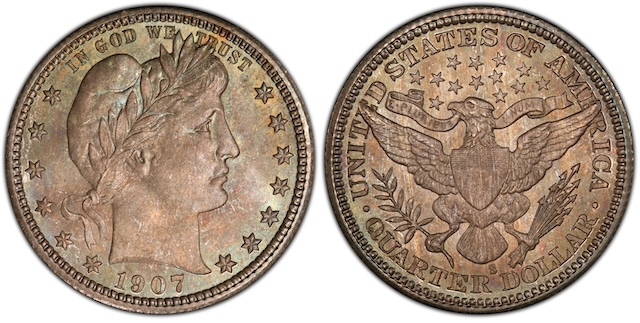
🔵 Common 1907-P Quarter
- No mint mark on reverse
- Philadelphia strike — often sharper
- Mintage: 7.1 million
- Worn examples: $15–$28
- Gem MS65 examples: ~$600
🟡 Scarce 1907-S Quarter
- Small "S" below eagle's tail feathers
- Lowest mintage of 1907 — 1.36 million
- Worn examples: $23–$47
- Mint State grades command big premiums
- High-grade examples are notably scarce
Check all that apply to your coin:
1907 Barber Quarter Value Chart at a Glance
Values below reflect current market data from PCGS, Heritage Auctions, and active dealer listings. For a comprehensive illustrated step-by-step 1907 quarter identification breakdown, consult this complete Barber quarter grading reference and identification walkthrough. Gold row = 1907-S; red row = 1907-O (strike rarity).
| Variety | Worn (G–F) | Circulated (VF–AU) | Uncirculated (MS60–63) | Gem (MS64–MS67+) |
|---|---|---|---|---|
| 1907-P (Philadelphia) | $15 – $28 | $32 – $210 | $228 – $390 | $400 – $1,560+ |
| 1907-D (Denver) | $15 – $32 | $32 – $210 | $230 – $400 | $400 – $1,800+ |
| 1907-D FS-301 (DDO+RPD) | $95 – $200 | $200 – $800 | $800 – $2,000 | $2,000 – $3,150+ |
| 1907-O (New Orleans) ⚠️ Weak Strike | $18 – $32 | $32 – $210 | $230 – $500 | $500 – $31,000+ |
| 1907-S (San Francisco) ★ Key Date | $23 – $47 | $47 – $280 | $280 – $800 | $800 – $86,500+ |
| 1907-S/S FS-501 (RPM) | $95 – $180 | $180 – $380 | $380 – $500 | $500 – $575+ |
| 1907 Proof (Philadelphia) | $400 – $1,000 (PR60–63) | $1,000 – $2,000 (PR64–65) | $2,500 – $4,200+ (PR67–68) | |
📱 CoinKnow lets you snap a photo of your 1907 quarter and instantly cross-check the variety and grade against live market data — a coin identifier and value app.
Quick Navigation
The Valuable 1907 Barber Quarter Errors & Varieties (Complete Guide)
The 1907 Barber Quarter series includes several documented die varieties and mint errors recognized by CONECA, the Fivaz-Stanton reference, and major grading services. Below are the five most important — each with identification tips, value data, and key diagnostics. Authentication by PCGS or NGC is strongly recommended for any variety you believe you've found.
 Most Famous
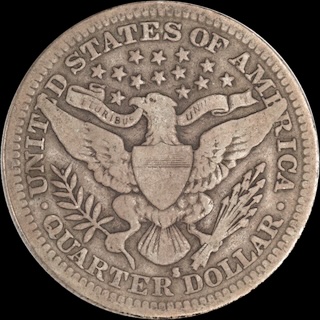
1907-S — The Key Scarce Date
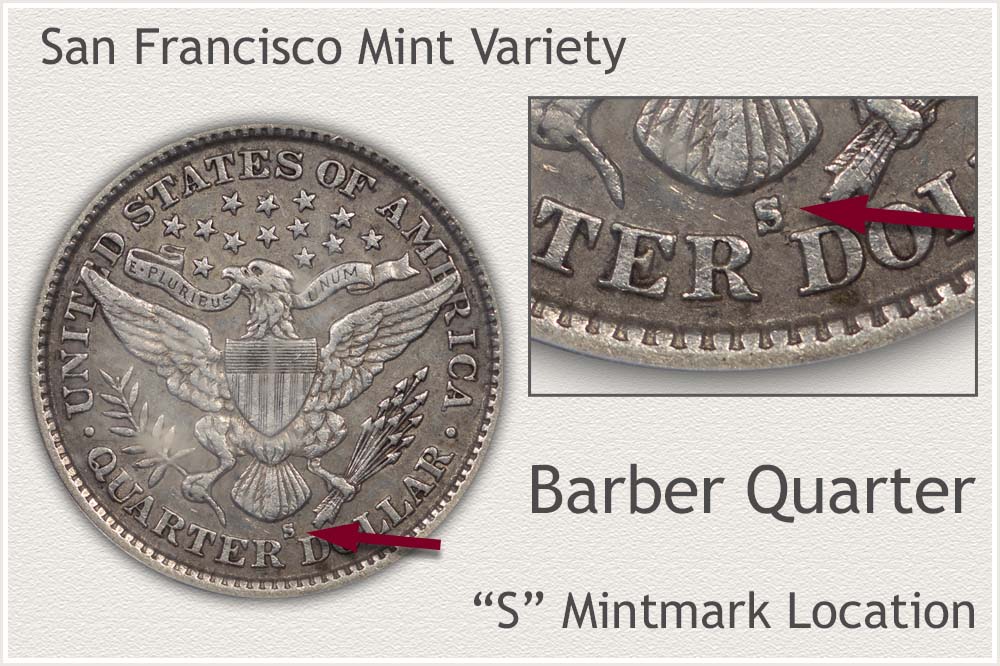
$23 – $86,500+The 1907-S is the undisputed standout of the year's four-mint production run. With just 1,360,000 coins struck at San Francisco, it represents less than 9% of total 1907 quarter output. Demand consistently outpaces supply at all grade levels, making this the coin that collectors actively seek when assembling a complete Barber quarter set.
To identify it, examine the reverse below the eagle's tail feathers for a bold "S" mint mark. On a genuine 1907-S, the S appears cleanly punched without obvious tilting or doubling (unless it's the FS-501 variety). The obverse exhibits Charles Barber's classic Liberty head design with LIBERTY inscribed on the headband — in Fine condition, most letters remain legible.
Collectors pay substantial premiums because MS-grade 1907-S quarters are genuinely rare in the marketplace. The Greysheet lists the range extending to $86,500 for highest-grade certified examples. Even worn examples in Good grade trade at a measurable premium over Philadelphia and Denver issues of the same year.
 Most Valuable Variety
1907-D DDO & RPD — FS-301
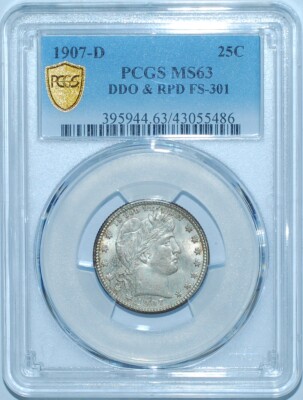
$95 – $3,150+The 1907-D FS-301 is a major catalogued die variety that combines two distinct hub errors: a Doubled Die Obverse (DDO) and a Repunched Date (RPD). It is designated FS-301 in the Fivaz-Stanton reference and is also listed by CONECA. The doubling originates from a misaligned second hubbing when the working die was sunk, locking the error permanently into every coin struck from that die.
Visually, the doubling is most apparent on stars 1 and 2 at the lower left of the obverse, and on the ribbon ends below Liberty's portrait. Under a 10× loupe, collectors can also detect the repunched date — an earlier, slightly offset punch of "1907" that appears as a shadow or shelf behind the primary date digits. The combination of both features on a single coin is what makes FS-301 especially significant.
Collectors prize this variety because combined DDO+RPD coins are uncommon even among die varieties, and the clear diagnostics make attribution straightforward with proper magnification. In MS-63 grade, where a standard 1907-D realizes around $350–$400, an authenticated FS-301 has reached $2,400 at retail, representing a premium of over 350%.
 Best Kept Secret
1907-S/S Repunched Mint Mark — FS-501
$260 – $575+The 1907-S/S FS-501 is a recognized repunched mint mark (RPM) variety where the "S" mint mark punch was applied twice to the working die, with the second impression offset from the first. This was a common occurrence in the Barber era when mintmark punches were applied by hand to each individual working die before hardening. The resulting doubled "S" is visible under magnification on authentic examples.
To identify this variety, examine the reverse mint mark under a 10× loupe. A genuine FS-501 shows a secondary "S" impression that is offset — typically at a slight angle or position shift relative to the primary "S." The overlapping curves of the two punches create a thickened or shadowed appearance that is distinct from die polishing or circulation damage to the mint mark.
Though less dramatic in dollar value than the FS-301, the FS-501 is an attractive variety that adds a meaningful premium above a standard 1907-S. At lower grades where a normal 1907-S might trade for $50–$100, a confirmed FS-501 typically adds 50–100% or more. Greysheet prices range from $260 in lower grades to $575 in nicer circulated examples.
 Strike Rarity
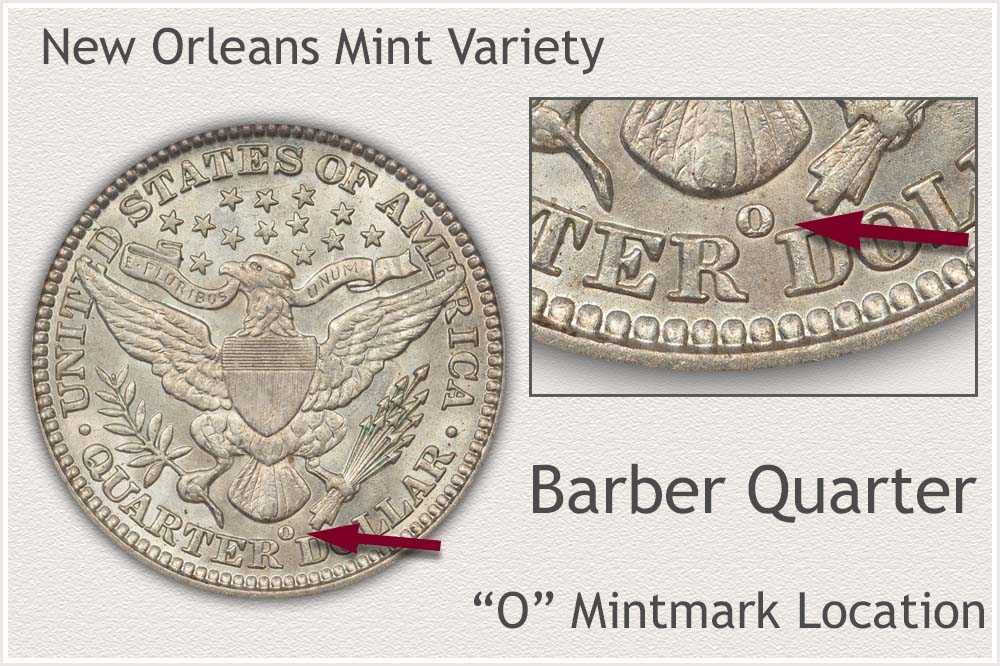
1907-O New Orleans — The Notorious Weak Strike
$18 – $31,000+The 1907-O is unique in the entire Barber quarter series for the severity and consistency of its striking weakness. Expert numismatists Q. David Bowers and John Frost have both documented that the 1907-O is considered the most poorly and unusually struck coin in the series — a distinction that paradoxically drives value upward at the highest grade levels. New Orleans Mint die alignment and press pressure issues created recurring problems across the 4,560,000-coin production run.
The most diagnostic visual feature of the 1907-O is the "mumps" effect — characteristic distortions on Liberty's neck and jaw area on the obverse, along with incomplete eagle claw detail on the reverse. Many examples also show scars and surface anomalies not seen on Philadelphia or Denver issues of the same year. Ironically, finding a sharply struck 1907-O without these anomalies is the true challenge for collectors.
Because a sharp-striking 1907-O is so elusive, a Stack's Bowers auction in 2020 realized an extraordinary $187,372 for a PCGS MS67+ CAC example — one of the finest known. Even more typical Mint State examples in the MS62–MS63 range command premiums above comparable Philadelphia strikes, because any 1907-O that escaped the characteristic weakness is immediately desirable to type and date collectors alike.
 Collector's Proof
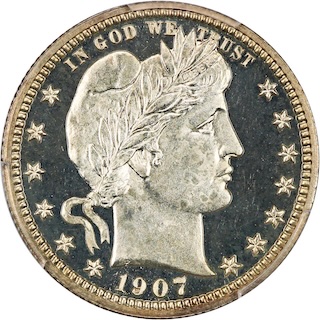
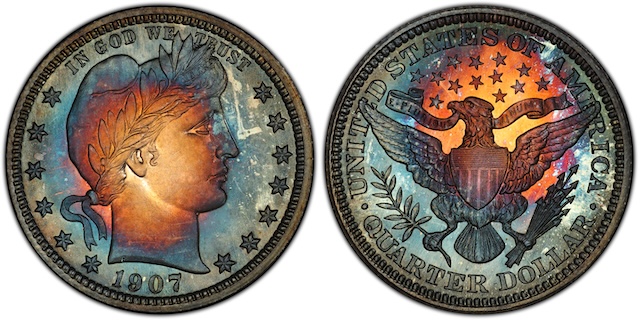
1907 Proof — Only 575 Struck
$400 – $4,200+The Philadelphia Mint struck only 575 proof examples of the 1907 Barber Quarter, making them among the scarcest numismatic issues of the year. Proof coinage of the era involved specially prepared dies and planchets, individually hand-fed into presses at reduced speed and higher pressure to produce sharp details and mirror-like fields. These were sold directly to collectors at a premium over face value through the Mint's annual proof set program.
Proof 1907 quarters are distinguished from business strikes by their perfectly flat, mirror-polished fields and sharply frosted (cameo) design devices. Under magnification, every detail of Charles Barber's Liberty head design is rendered with maximum crispness. Cameo and Deep Cameo examples — where the contrast between frosted devices and mirror fields is especially dramatic — command significant premiums above standard proof issues.
With only 575 made and decades of attrition, surviving proof 1907 quarters are consistently sought after at major auction events. Heritage Auctions has sold PR67 Cameo examples for $3,840 and NGC PR68★ Cameo specimens for over $4,200. Even lower-grade proof examples (PR60–PR63) typically trade for several hundred dollars, well above any circulated business strike counterpart.
Found one of these errors on your coin?
Use the calculator above to get an instant value estimate based on your mint, condition, and variety.
1907 Barber Quarter Mintage & Survival Data
| Mint | Mint Mark | Mintage | Collector Notes |
|---|---|---|---|
| Philadelphia | None | 7,132,575 + 575 Proofs | Most common; proofs extremely rare |
| New Orleans | O | 4,560,000 | Notorious for weak strikes and mumps |
| Denver | D | 2,484,000 | Hosts the FS-301 DDO+RPD variety |
| San Francisco | S | 1,360,000 | Key scarce date; premium in all grades |
| Total (Business Strike) | — | 15,536,575 | All 90% silver, 6.25g, 24.3mm |
Silver content: ~0.1808 troy oz per coin · Melt value: Fluctuates with silver spot price
How to Grade Your 1907 Barber Quarter
Accurate grading is the single most important factor in determining your coin's value. Use the four condition tiers below and check both sides of your coin carefully.
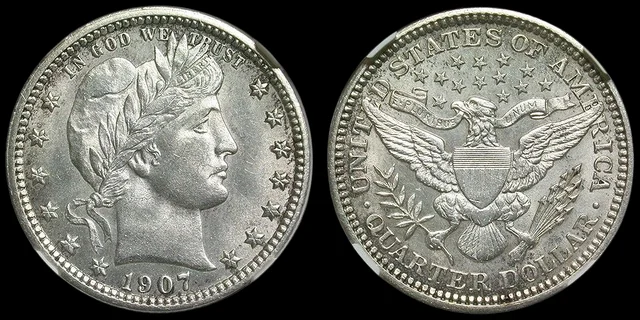
🟤 Worn (Good – Fine / G-4 to F-12)
The portrait is flat and smooth in the high points. In Good, the design outline, stars, date, and lettering are barely visible. In Fine condition, most of "LIBERTY" appears on the headband — 4–6 letters typically legible. Eagle feather detail is largely gone. These coins trade near silver melt value for common dates ($15–$28), with 1907-S commanding $23–$47 even worn.
🔵 Circulated (VF–AU / VF-20 to AU-58)
Very Fine shows clear "LIBERTY" and distinct hair strands above the forehead. Extremely Fine retains sharp headband detail with the full "LIBERTY" inscription bold and both edges of the ribbon defined. About Uncirculated shows only the slightest rub on the highest points (cheek, hair, eagle tail feathers) with significant remaining luster in protected areas. Values from $32 to $280+ depending on mint and exact grade.
🟡 Uncirculated (MS60–MS63)
No wear at all, but may have numerous contact marks or bag marks from handling and storage. Mint luster is present across all surfaces. MS60 examples show heavy marks; MS62 shows moderate marks with good luster; MS63 has fewer distractions and above-average eye appeal. Denver and New Orleans issues in MS60–63 may still show their characteristic soft strike at the eagle's claw — this is a strike issue, not wear, and affects grading.
⭐ Gem (MS64–MS67+)
Exceptional strike, near-perfect surfaces, and full original luster. MS64 allows minor marks or a slightly weak strike area. MS65 shows minimal contact marks and strong overall eye appeal. MS66 and MS67 are genuinely rare for most 1907 dates — the top certified PCGS/NGC population drops sharply above MS65. Gem examples of the 1907-S and 1907-O are numismatic rarities and have sold for thousands to over $100,000 in top conditions.
🔎 CoinKnow can help you match your coin's surfaces against graded examples to narrow down a condition range before submission — a coin identifier and value app.
Where to Sell Your Valuable 1907 Quarter
The right venue depends on your coin's grade, variety, and certification status. Here's an honest breakdown.
🏛️ Heritage Auctions
Best for: MS-grade, certified, or proven error/variety coins (especially 1907-S, FS-301, or proof examples).
Heritage reaches the deepest pool of serious Barber quarter collectors. They handle the majority of high-value Barber quarter sales recorded in this guide. Consignment fees apply but competitive bidding frequently exceeds other venue prices for quality coins.
🛒 eBay (Completed Listings)
Best for: VF through AU examples, certified mid-grade coins, or clearly identified varieties.
eBay offers the broadest buyer audience for mid-range 1907 quarters. Check the recently sold prices for 1907 Barber Quarter listings and completed auction results before pricing your coin to calibrate expectations. PCGS or NGC certification significantly increases buyer trust and final prices on eBay.
🏪 Local Coin Shop
Best for: Worn or common-date examples where speed matters more than maximizing price.
A local dealer will offer you immediate cash, typically at 50–70% of retail for common circulated 1907 quarters. Prices improve for nicer or certified coins, but dealers build in a margin for resale. Useful for quick liquidation without shipping or auction waiting periods.
💬 Reddit r/Coins & Collector Forums
Best for: Raw (ungraded) coins in mid-grade where the buyer wants to save on certification fees.
Subreddits like r/Coins4Sale connect you with knowledgeable collector-buyers who often pay fair retail for raw problem-free coins. Post clear photos of both sides with good lighting. Experienced buyers will evaluate grade honestly and many prefer buying from fellow collectors over dealers.
Frequently Asked Questions — 1907 Quarter Value
How much is a 1907 Barber Quarter worth?
A heavily worn 1907 Philadelphia quarter is worth around $15–$20 for its 90% silver content. In Fine condition it reaches $28–$45, in Extremely Fine $65–$140, and in Mint State $120–$280 depending on the mint. The 1907-S is the scarcest issue and commands the highest premiums in all grades. Top auction records exceed $17,000 for exceptional gem examples.
Which 1907 quarter is most valuable?
The 1907-S is the most valuable regular-strike 1907 quarter due to its low mintage of 1,360,000 — the fewest of all four mints that year. In Mint State grades it is considered rare, and gem examples are especially prized. The 1907-O in very high grades (MS67+) has also set extraordinary records. Error varieties like the 1907-D FS-301 doubled die can also carry significant premiums above normal strikes.
What is the 1907-D FS-301 doubled die variety?
The 1907-D FS-301 is a recognized CONECA and Fivaz-Stanton catalogued variety that combines a Doubled Die Obverse (DDO) with a Repunched Date (RPD). The doubling is visible on stars 1 and 2 and on the ribbon ends. It commands premiums of 350% or more over a standard 1907-D in comparable grades. Authentication by PCGS or NGC is essential to confirm genuineness and realize full premium value.
How do I find the mint mark on a 1907 quarter?
Mint marks on 1907 Barber Quarters are located on the reverse side of the coin, just below the eagle's tail feathers and above the text 'QUARTER DOLLAR.' A 'D' indicates Denver, 'O' indicates New Orleans, and 'S' indicates San Francisco. Philadelphia struck coins have no mint mark — an empty space in that area confirms a Philadelphia issue. Use a 5× to 10× loupe for a clear view.
What makes the 1907-O quarter special?
The 1907-O is notorious among Barber quarter specialists for being the most weakly and unusually struck coin in the series. Many examples display 'mumps' — distortions on the neck and jaw — along with scars and incomplete details. Despite a mintage of 4,560,000, finding a sharply struck 1907-O in high Mint State grades is extremely difficult, and exceptional examples have sold for over $100,000 at major auctions.
Are 1907 proof quarters valuable?
Yes. The Philadelphia Mint struck only 575 proof 1907 quarters, making them rare collector pieces. In lower proof grades (PR60–PR63), values range from several hundred to over $1,000. Cameo proof examples at PR67 or PR68 have sold for $2,600 to $4,200 at Heritage Auctions. The tiny mintage means even average-quality proof examples are desirable and scarce.
What is the 1907-S/S Repunched Mint Mark (FS-501)?
The 1907-S/S FS-501 is a repunched mint mark variety where a second 'S' impression was punched slightly offset from the first, leaving a doubled 'S' mintmark visible under magnification. It is catalogued as FS-501 in the Fivaz-Stanton reference. Values range from approximately $260–$575 across grades according to Greysheet. As with all varieties, professional authentication is strongly recommended.
Is a 1907 quarter made of silver?
Yes. All 1907 Barber Quarters are composed of 90% silver and 10% copper, with a total weight of 6.25 grams. This means each coin contains approximately 0.1808 troy ounces of pure silver. The melt (intrinsic silver) value fluctuates with the silver spot price but typically ranges from $4 to $6 at common silver prices. Even heavily worn examples are worth at least their silver melt value.
How do I grade my 1907 quarter at home?
Start with the obverse: in Good condition, the portrait and date are visible but flat. In Fine, 'LIBERT' or full 'LIBERTY' shows on the headband. In Extremely Fine, the headband letters are sharp and hair detail above the forehead is visible. In Mint State, all surfaces retain original luster with no rub or wear at all. Check the reverse eagle's tail feathers and wing tips for wear too. A 10× loupe helps distinguish Fine from Very Fine.
Where can I sell my valuable 1907 quarter?
For coins in Mint State or problem-free high circulated grades, major auction houses like Heritage Auctions offer the widest collector audience and can maximize prices. eBay is a good option for mid-range coins (Fine through AU), especially if PCGS or NGC certified. Local coin shops offer immediate cash but at wholesale prices. For scarce varieties like the 1907-S or FS-301, professional grading before selling almost always increases net proceeds significantly.
Ready to find out what your 1907 quarter is worth?
Use the free calculator above — takes less than a minute, no account needed, instant result.
Calculate My 1907 Quarter Value →